MEGAWAT
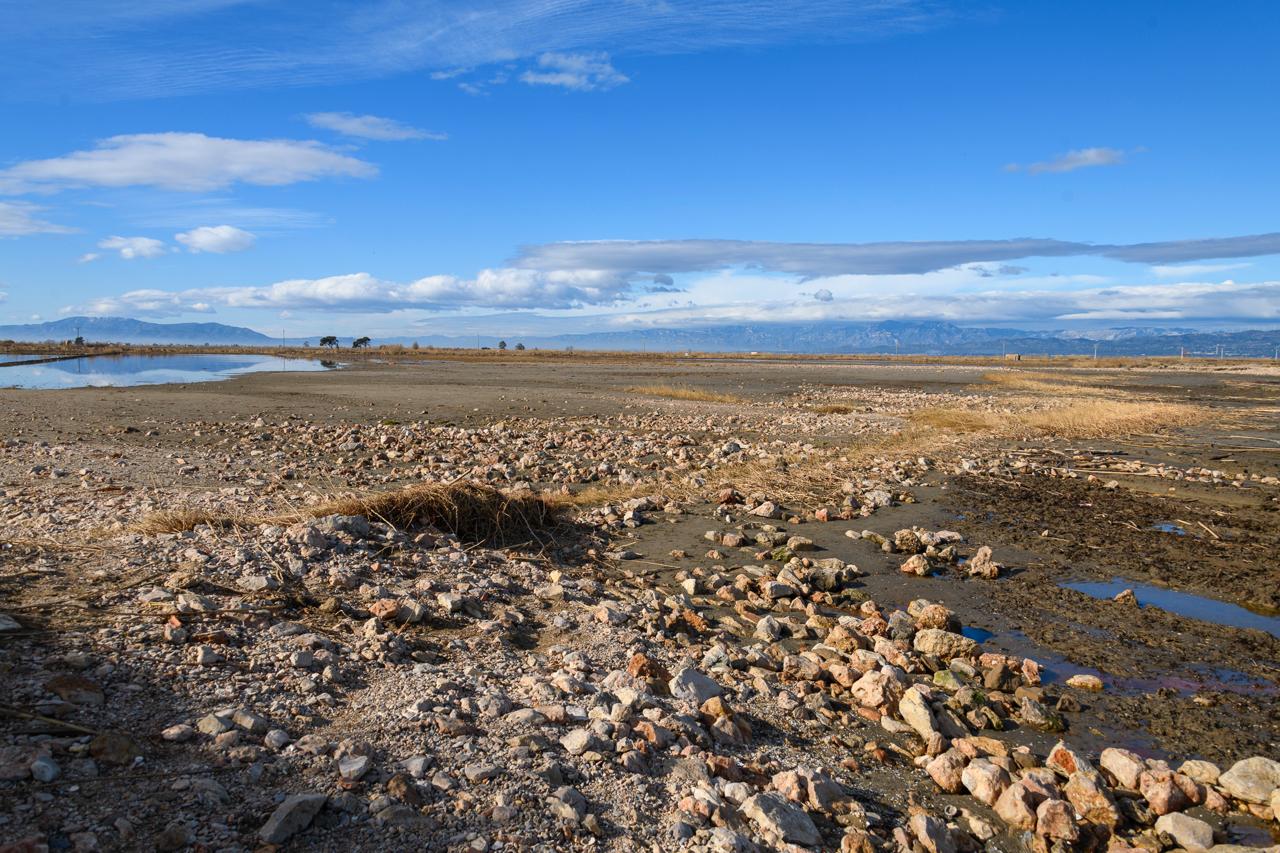
Ebro basin. Photo: José A. Sartorio – www.artslow.es
Work Package 1
We investigate the atmospheric processes involved in past droughts and future megadroughts to understand the mechanisms responsible for the lack of precipitation and co-occurring heatwaves. Precipitation in Europe is related to specific weather systems, and lack of precipitation can be due to the absence of these systems and/or their reduced “precipitation efficiency” (e.g. related to reduced forcing for ascent or reduced regional moisture availability).
Work Package 2
WP2.1 Ensemble boosting
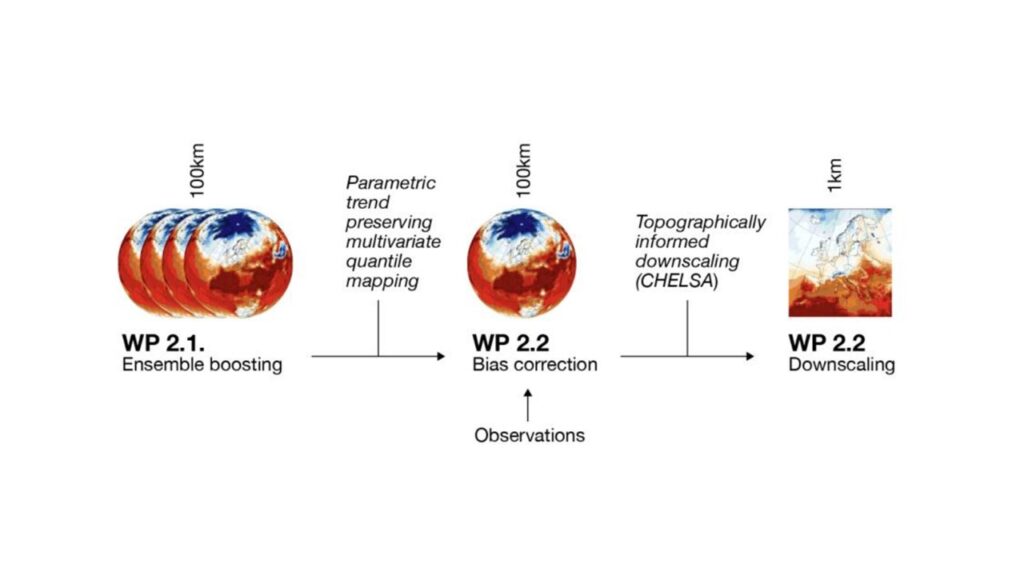
Thanks to new innovative techniques we can simulate a large number of extreme droughts in regions of interest with a much reduced computational cost compared to classical techniques. We will simulate extreme meteorological droughts using the CESM2 fully coupled climate model.
WP2.2. High resolution downscaling of reanalysis and climate model output
The high-resolution land surface model Tethys-Chloris (T&C) requires input data at a higher spatio-temporal resolution than that of the climate model of WP2.1. Due to the complexity of mountain terrain, atmospheric variables can vary considerably within small spatial extents. We will use the CHELSA (Climatologies at high resolution for the Earth’s Land surface areas) downscaling model (Karger et al., 2017, 2021, 2022) to scale the input data to the resolution needed by T&C. CHELSA uses a computationally efficient mechanistic downscaling approach. We will produce a high spatial (250 m) and temporal (daily) resolution downscaled dataset of air-temperature, short and longwave radiation, relative humidity, surface pressure, wind speed, and precipitation for specific alpine regions in Europe using the ensemble boosted climate scenarios from WP2.1 and reanalysis climate data for past extreme droughts. To bias correct the future climate scenarios, we will follow the parametric, trend-preserving quantile mapping ISIMIP3b BA method (Lange et al., 2019). The downscaled data will be made available open access to the scientific and water management community to facilitate impact modelling of megadroughts in Europe beyond the duration of this project.
Work Package 3
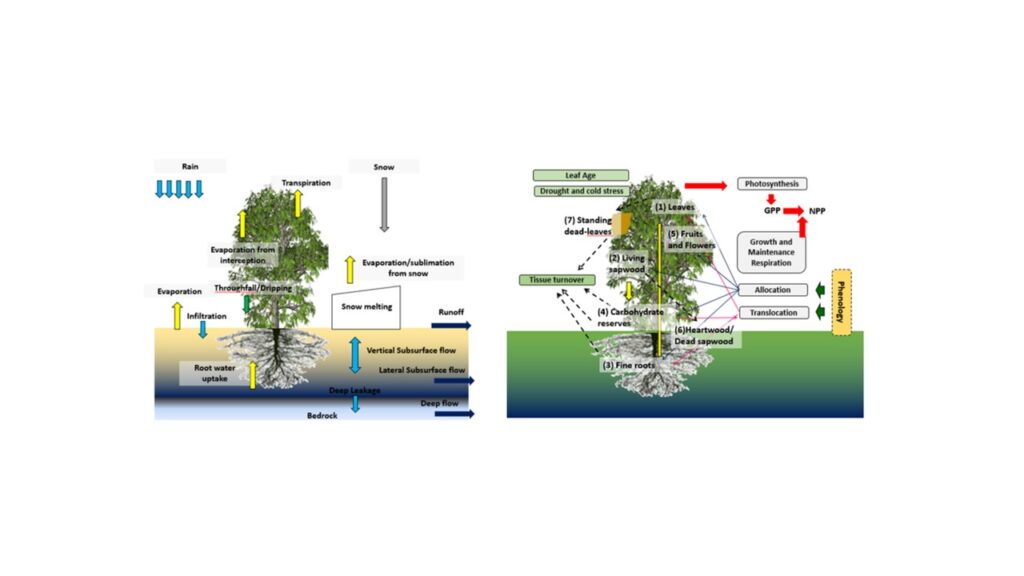
In an effort to unravel the consequences of multi-year droughts in Europe, we have selected catchments in the Pyrenees, Apennines and Alps with varying presence of glaciers, snow cover and trees. To study the catchments, we employ the ecohydrological model Tethys-Chloris, which provides a comprehensive way for modelling variables susceptible to change under drier conditions such as evapotranspiration, snow cover area and gross primary production. Moreover, our modelling approach allows us to assess these variables across the entire catchments giving us unprecedented insights into their long-term evolution. The results of our investigation will provide a solid base for stakeholders to foresee and reduce the consequences of climate change.
Work Package 4
WP4 focuses on drought decision support and adaptation, developing:
- A resilience framework to assess water management and adaptation strategies in drought hotspots.
- Cryosphere-related drought indices from satellite data to enhance Early Warning Systems
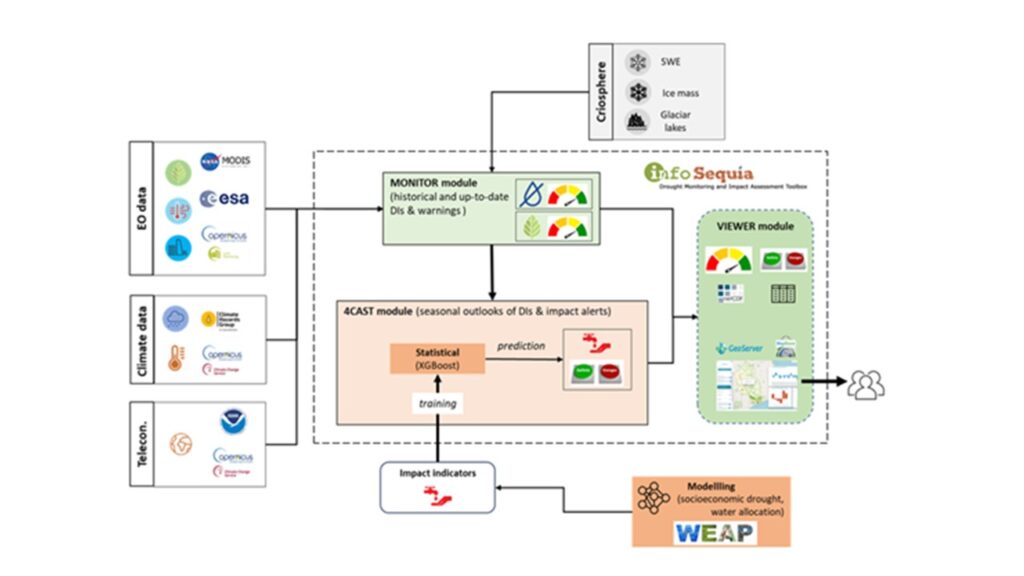
The generation and the integration of snow drought indicators in the FutureWater’s Drought Early Warning System called InfoSequia (figure below).
The work integrates snow drought indicators in the FutureWater’s Drought Early Warning System called InfoSequia (see Figure), linking glaciers, snowpacks, and aquifers to drought vulnerability and resilience in downstream regions. The approach is stakeholder-driven, with hotspots selected based on modeling.
Work Package 5
The WP5 has three functions: a) conduct a European-wide problem analysis across the stakeholders-scientists divide; b) facilitate interactions between stakeholders, decision makers, the public and the investigators; and c) maximise the translation of outcomes to broader impacts. To these goals, the following activities are planned: i) general survey conducted with the main stakeholders in the areas of interest to assess main bottlenecks in identifying and/or implementing adaptation measures (i.e. uncertainty on scenarios, lack of data, lack of fundings, governance, concurrent uses, lack of technologies, etc.); ii) organization of a series of workshops with the stakeholders of the identified pilots to discuss scenarios from WP3 and WP4 and possible mitigation measures